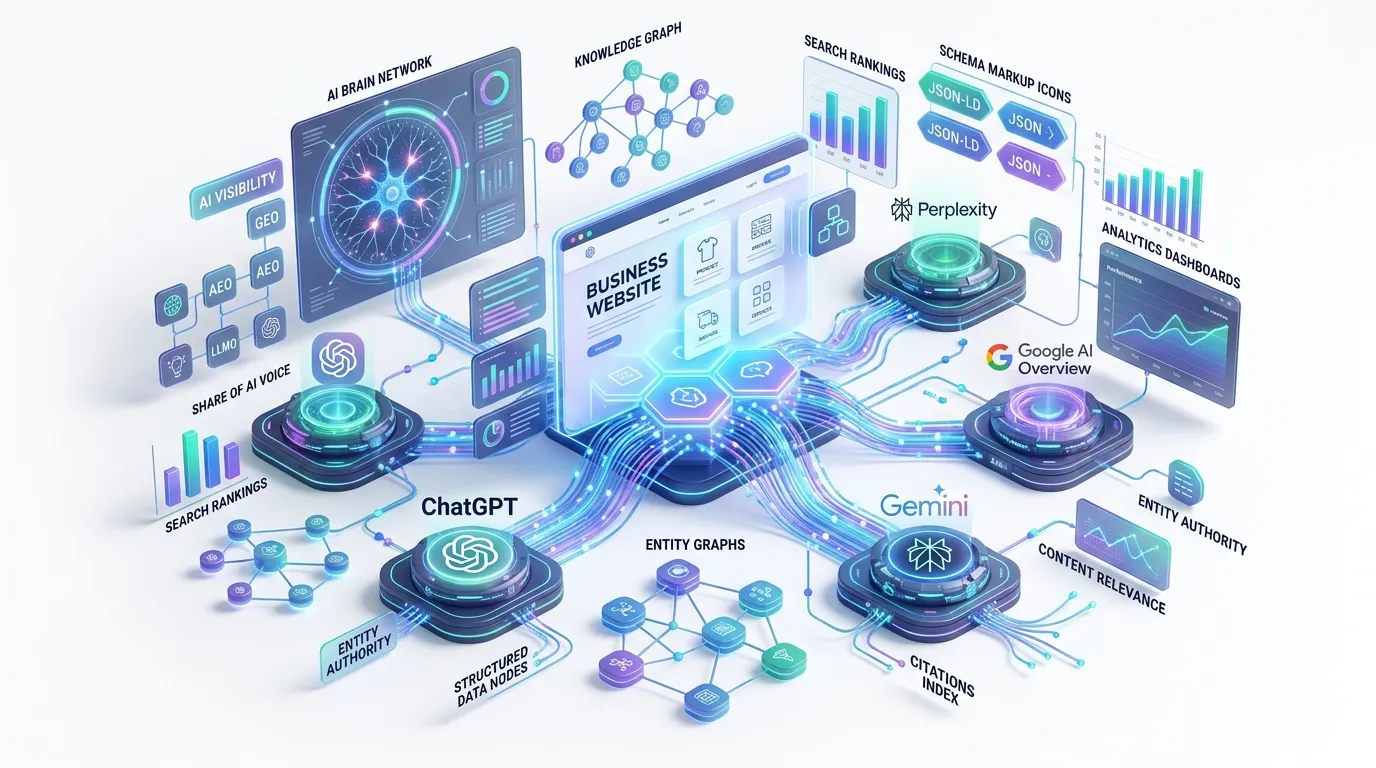
Businesses should use AI search optimization tools because search behavior has fundamentally shifted. Tools like ChatGPT, Gemini, and Perplexity now answer questions directly, bypassing traditional search results. AI search optimization tools help businesses appear in those AI-generated answers, track brand visibility in large language models, and build lasting authority that drives qualified traffic.
People no longer search the way they used to. They ask full questions. They expect direct answers. And they get them, without ever clicking a link.
This shift is reshaping how businesses get found online, and it raises an urgent question for every business owner: if your customers are getting answers from AI tools like ChatGPT, Perplexity, and Gemini, does your brand appear in those answers? If not, you are missing a growing share of your market.
This is exactly why use AI search optimization tools for your business has become one of the most important decisions you can make right now. AI search optimization tools help businesses show up where modern buyers look first. They track visibility inside AI-generated answers, improve how content is structured for AI engines, and build the kind of brand authority that earns citations from tools like Gemini and Perplexity.
This post explains what AI search optimization tools actually do, why traditional SEO alone no longer cuts it, and the concrete benefits these tools bring to businesses of every size.
The Way People Search Has Changed
Search used to be simple. Someone typed a few keywords into Google, scanned the results, and clicked a link. That process is becoming less common.
More users now type complete questions into ChatGPT or Perplexity and receive a structured, direct answer. Others ask Google a question and see an AI Overview at the top of the page, summarizing an answer before any organic results appear. These are called zero-click searches, and they are growing fast. When users get their answer directly from an AI summary, they never visit a website at all.
This creates a real problem. Businesses that invest heavily in traditional SEO, climbing to page one of Google, may find that fewer people ever see those rankings. The answer appears above the results. The click never happens.
For businesses across the USA, this is not a distant concern. It is happening now, across nearly every industry and search category.
What Is AI Search Optimization and Why Does It Matter?
AI search optimization is an umbrella term for a set of strategies designed to help your business appear inside AI-generated answers, not just traditional search rankings.
There are three key disciplines under this umbrella:
GEO (Generative Engine Optimization) focuses on optimizing your content so that AI tools like ChatGPT and Gemini pull from your pages when generating answers. Traditional SEO targets page rankings. GEO targets citations in generative answers.
AEO (Answer Engine Optimization) focuses on structuring your content so it directly answers questions users ask. It makes your content easy for AI systems to extract, summarize, and cite.
LLMO (LLM Optimization) refers to optimizing your brand's presence within large language models themselves, ensuring that tools like ChatGPT and Perplexity recognize your business as a credible, relevant source.
Together, these disciplines make AI visibility optimization a measurable business goal. You can track how often your brand appears in AI answers, compare it against competitors, and improve over time. RRDPress LLC works with businesses to build and execute strategies across all three areas, turning AI visibility into a concrete growth lever.
Why Traditional SEO Is No Longer Enough
Traditional SEO still matters. But it was built for a different search environment.
Google AI Overviews now appear at the top of results for a broad range of queries. A user searching for a product recommendation, a how-to answer, or a business comparison may see a full AI summary before scrolling to any organic links. Studies tracking search behavior show that a rising share of searches now end without a single website click.
Tools like Perplexity and ChatGPT go further. They pull from sources with strong entity authority and topical depth, not just high domain authority scores. A business with deep, well-structured content on a specific topic may get cited ahead of a larger competitor with a stronger overall domain, simply because its content answers the question more clearly.
For businesses already investing in content marketing, AI search optimization tools are the natural next step. They extend that investment into the channels where buyers increasingly look first.
What AI Search Optimization Tools Actually Do
At a practical level, AI search optimization tools perform several functions that traditional SEO platforms do not cover.
Track AI visibility. These tools monitor where and how your brand appears inside AI-generated answers. You can see which questions trigger mentions of your business, how frequently those mentions occur, and what context surrounds them.
Monitor brand in LLMs. When ChatGPT, Gemini, or Perplexity mention your business, what do they say? AI search tools capture these mentions and flag inaccurate or missing information, so you can take action.
Optimize for Google AI Overviews. Content structured with the right headings, clear answers, and structured data is far more likely to be selected by Google's AI when generating an overview. These tools identify where your existing content falls short.
Implement schema markup. Structured data tells AI engines exactly who you are, what you offer, and why you are a credible source. Schema markup is one of the most direct ways to improve eligibility for citations in generative answers, and AI SEO tools help you implement it correctly.
Even for small teams with limited resources, these tools make complex tasks manageable. You do not need a dedicated SEO department to benefit.
The Benefits of AI Search Optimization for Your Business
The business case for AI search optimization is straightforward.
Stronger brand visibility. Appearing in the answers users actually read is more valuable than appearing in a list of links they scroll past. AI-generated answers get attention. Being cited there puts your brand in front of users at the exact moment they are making decisions.
Citations in generative answers. When Perplexity or ChatGPT cites your business as a source, it signals credibility. Users trust AI-generated citations in a way they may not trust a sponsored ad. This trust translates into qualified traffic and stronger inbound leads.
Share of AI voice. This metric measures how often your brand appears in AI-generated responses relative to competitors. It is becoming a key performance indicator for forward-thinking marketing teams, and businesses that invest now are building a lead that compounds over time.
Competitive edge in AI search. Most businesses have not yet optimized for GEO or AEO. The ones that act now build entity authority and topical recognition before competitors catch on. Closing that gap later will be far harder.
Consider a small B2B service provider that starts appearing consistently in ChatGPT answers about their niche. Buyers who ask about industry solutions begin seeing that company cited as a credible option. Inbound leads increase, not from ads, but from organic AI visibility.
How AI Tools Support the B2B Buyer Journey
B2B buying has changed. Buyers now conduct extensive research before they ever contact a vendor. Much of that research happens through AI tools.
A procurement manager evaluating software vendors might ask ChatGPT to compare options, ask Perplexity for a summary of industry solutions, or prompt Gemini to recommend vendors with specific capabilities. These are research moments. They happen early in the buying process, before a sales conversation ever starts.
Businesses that optimize for AEO become part of that research phase. A company cited in a Perplexity answer about supply chain software, for example, earns credibility before the buyer has even visited their website. By the time that buyer reaches out, the brand is already familiar.
This is how AI tools support the B2B AI buyer journey. Optimizing for AEO means your business shows up during research, not just at the bottom of a funnel.
AI SEO Workflow Efficiency: Doing More with Less
One of the most practical benefits of AI search optimization tools is time savings. Manual SEO work is slow. Keyword tracking, content gap analysis, competitor monitoring, and performance reporting can consume hours every week.
AI-powered SEO tools automate much of this. They surface keyword opportunities, flag content gaps, and monitor changes in AI search results automatically. This AI SEO workflow efficiency is especially valuable for lean teams.
Faster content production is another benefit. Structured content performs better in AI search results. AI-powered tools help teams produce well-structured, authority-rich content more quickly, with clear headings, direct answers, and properly formatted data that AI engines can easily extract and cite.
A task that once took a content team several hours of research and formatting can be completed in a fraction of the time, without sacrificing quality.
Building Entity Authority and Topical Depth
Two concepts sit at the heart of AI search optimization: entity authority and topical depth.
Entity authority refers to how well-known and trusted your business is as a specific entity within AI knowledge systems. When ChatGPT or Gemini knows what your business does, who it serves, and what makes it credible, they are more likely to cite it. Entity authority builds through consistent, accurate information across credible platforms, structured data that defines your business clearly, and citations from trusted sources.
Topical depth means covering a subject so thoroughly that AI engines recognize your site as a go-to resource on that topic. A business that publishes one surface-level article about a subject will not be seen as authoritative. A business with a deep library of clear, well-structured content on a specific topic earns recognition over time.
Practical ways to build both:
Publish consistent, in-depth content around your core topics
Use schema markup to define exactly who you are and what you do
Build citations across credible platforms and directories
Link internally between related content to demonstrate topical coverage
Both entity authority and topical depth directly influence whether tools like ChatGPT or Gemini cite your business in their answers.
How to Track and Measure AI Visibility
Standard web analytics tools do not capture AI visibility. Google Analytics tracks clicks from search results, but if a user reads about your business in a ChatGPT answer and then visits your site directly, that traffic appears as direct, with no AI attribution.
To properly track AI visibility, businesses need dedicated monitoring. Key metrics include:
Brand mentions in LLM responses: How often does ChatGPT, Gemini, or Perplexity mention your brand when answering relevant questions?
Share of AI voice vs. competitors: How does your brand's mention frequency compare to key competitors across AI tools?
Citation frequency in AI overviews and generative answers: How often does your content appear as a cited source in AI-generated summaries?
Treat this like a monthly SEO audit. Set a regular cadence for monitoring brand mentions in LLMs, reviewing citation patterns, and identifying gaps where competitors are appearing and your brand is not. RRDPress LLC can help businesses build a practical AI visibility monitoring framework tailored to their goals.
The ROI of GEO and AEO: Is It Worth the Investment?
The honest answer is that results take time. GEO and AEO are not pay-to-play channels. You cannot buy your way into a ChatGPT citation the way you can buy a Google ad placement.
But the ROI of GEO and AEO compounds in ways that paid advertising does not. A business that consistently appears in AI-generated answers for its niche builds recognition that paid ads cannot replicate. That recognition persists even when ad budgets go to zero.
Here is a simple scenario: a business invests six months in structured content, schema markup, and entity authority building. Over time, ChatGPT and Perplexity begin citing that business in answers about their industry. Inbound leads increase. Brand trust grows. The cost of that visibility does not scale with impressions or clicks. It scales with content quality.
For small business AI visibility, the ROI case is especially strong. AI search optimization levels the playing field. A small business with deep, well-structured content on a specific topic can earn citations ahead of a larger competitor, because AI engines reward relevance and clarity, not just budget.
The Right Time to Start Is Now
The shift is already underway. Search behavior has changed, AI tools are answering questions that used to drive website traffic, and businesses that ignore this shift are watching their visibility erode without realizing why.
The move from traditional SEO to GEO and AEO is not about abandoning what works. It is about extending your strategy into the channels where buyers spend their time. Appearing in ChatGPT answers, earning citations in Perplexity, and being recognized by Gemini as a credible source, these are the new markers of online authority.
Businesses that invest in AI visibility optimization now will build a durable competitive edge. Those who wait will find the gap harder to close as competitors establish entity authority and topical depth that takes months to build.
If you are ready to start, RRDPress LLC can help. Reach out to schedule a consultation, explore AI search optimization services tailored to your business, or get a clear picture of where your brand stands in AI-generated search today. The businesses building AI visibility now are the ones who will lead tomorrow.
Frequently Asked Questions
What is generative engine optimization (GEO) and how is it different from traditional SEO?
Generative Engine Optimization (GEO) focuses on getting your content cited within AI-generated answers from tools like ChatGPT, Gemini, and Perplexity. Traditional SEO focuses on ranking your pages in Google's organic search results. The key difference is the destination: traditional SEO targets ranked links, while GEO targets direct citations inside AI responses.
What is answer engine optimization (AEO) and who should use it?
Answer Engine Optimization (AEO) is the practice of structuring content so AI tools can easily extract and present it as a direct answer to a user's question. Any business that wants to appear in voice search results, Google AI Overviews, or conversational AI responses should prioritize AEO. It is especially valuable for B2B companies whose buyers research solutions through AI tools before contacting vendors.
How do AI search optimization tools help small businesses compete with larger companies?
AI search optimization tools level the playing field by rewarding content quality and topical depth over budget size. A small business with clear, well-structured content on a specific niche can earn citations in AI-generated answers ahead of larger competitors. Tools also automate tasks like competitor monitoring and content gap analysis, which would otherwise require a large team.
How long does it take to see results from GEO and AEO?
Results from GEO and AEO typically take three to six months to become measurable, depending on your current content foundation and how competitive your niche is. Entity authority and topical depth build gradually. The benefit, however, is that these gains compound over time rather than disappearing when a budget is paused.
What is "share of AI voice" and why does it matter?
Share of AI voice measures how often your brand appears in AI-generated responses compared to competitors. It is becoming a key performance indicator for businesses that track AI visibility. A higher share of AI voice means your brand is more likely to be seen, cited, and trusted by buyers who use AI tools during their research process.
How do I know if my brand is being mentioned in AI tools like ChatGPT or Perplexity?
Standard analytics platforms like Google Analytics do not track AI mentions. Dedicated AI visibility monitoring tools are needed to capture brand mentions in LLM responses, track citation frequency in AI overviews, and compare your brand's share of AI voice against competitors. Treating this as a monthly monitoring task, similar to a traditional SEO audit, is the recommended approach.
What is schema markup and why does it help with AI search visibility?
Schema markup is structured data added to your website's code that helps AI engines understand exactly who you are, what you offer, and what your content is about. It increases your eligibility for citations in generative answers and Google AI Overviews. AI search optimization tools can identify where schema markup is missing and help implement it correctly.